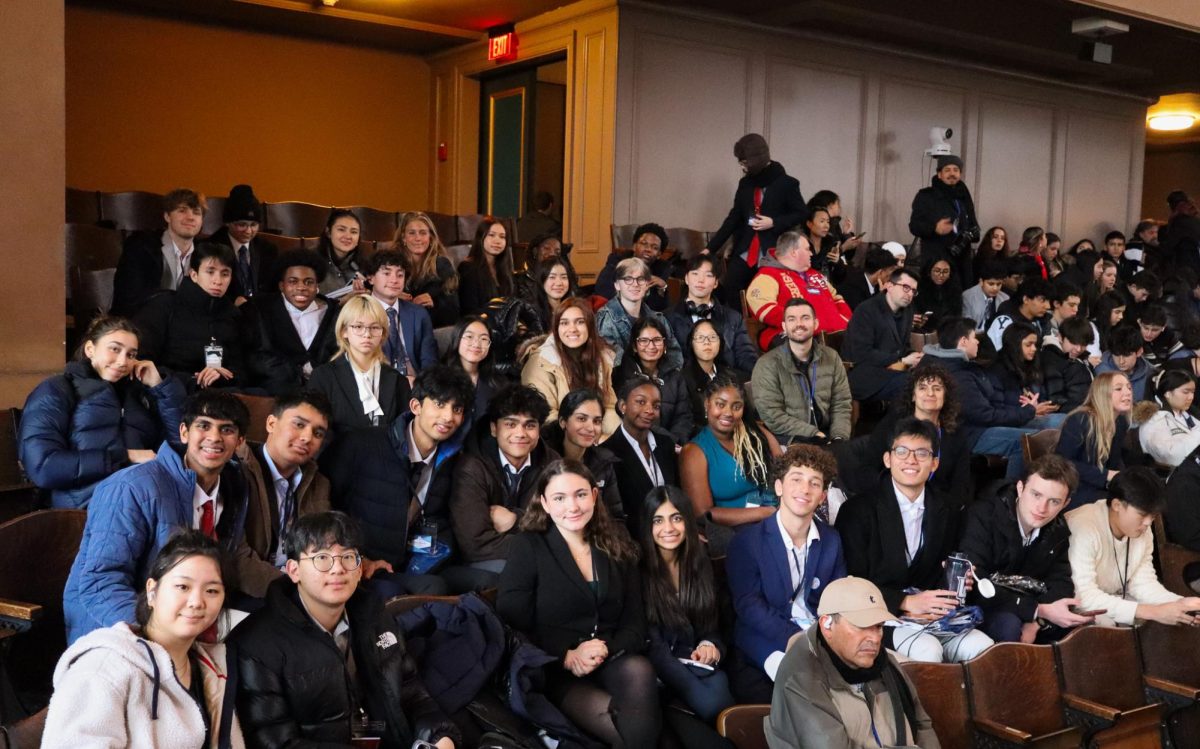
As AI grows increasingly adept at tasks once thought unique to humans, the crux is no longer what these machines can do, but what distinguishes humans from them. On Monday night, January 12, this philosophical question set the scene for the AI & Humanities Symposium held in the Norton Center for the Common Good by the Classics Club in collaboration with the Writing Initiatives and the Kravis Center for Excellence in Teaching. Prompting reflection on this year’s school-wide theme, “What does it mean to be human?”, the event invited the Loomis community to thoughtful discussions regarding technology and how humans subsequently ought to engage with it, while
During the event, various groups of students and faculty members delivered presentations on a wide array of topics concerning AI and ethics, including “mechanisms behind large language models (LLMs),” presented by Director of Educational and Administrative AI Initiatives Mr. Matthew Johnson, and “general usage of ChatGPT, along with the importance of human dialogue as interpreted through Socratic traditions,” presented by Lisa Pang ’27 and Vicky Jain ’28.
The inspiration behind the occasion, according to student organizer Pang ’27, had stemmed from a simple guiding initiative: “[Given the polarizing viewpoints over AI] how can we bring students and teachers together in a collaborative way?”
Regarding the significance of the symposium, Pang’27 also expressed her concern that unaddressed dissent between students and faculty members over the usage of AI would exacerbate existing academic tension. “The scary thing would be that students who don’t agree with this way of using generative AI [general prohibition] in the classroom find ways not to communicate what they’re thinking but to cut corners,” Pang said, suggesting that merely condoning such disputes would only further push students toward academic dishonesty rather than bringing about constructive engagement. As such, the symposium provided a necessary open forum that created space for dialogue and potential compromise between opposing perspectives on AI.
Tidal Fisher ’28, a student presenter, contended that “AI doesn’t necessarily deserve a negative or positive connotation.” Rather than the school vehemently tabooing AI, Fischer suggested a shift in educational priorities, adding that “schooling should teach you not only how to think but also how to teach AI to educate you.”
Strong voices regarding AI, either supportive or skeptical, are evident among both students and teachers. With the debate over AI growing increasingly polarizing, the focus has shifted away from the binary dilemma between acceptance and rejection and toward a deeper reflection of how emerging technologies should reshape the aims and methods of education.
Gary Kasparov, a former world chess champion best known for his game against IBM’s Deep Blue, once remarked, “AI won’t replace humans, but those who use AI will replace those who don’t.” Whether harnessing such a technology as AI would erode human ingenuity or simply elevate human capability –– much like any other technological advancement that came before –– remains a polarizing question. Yet as AI continues to advance rapidly, the symposium marked an initial step toward bridging long-standing divisions over its role in education, underscoring that silence is unlikely to resolve such tensions.