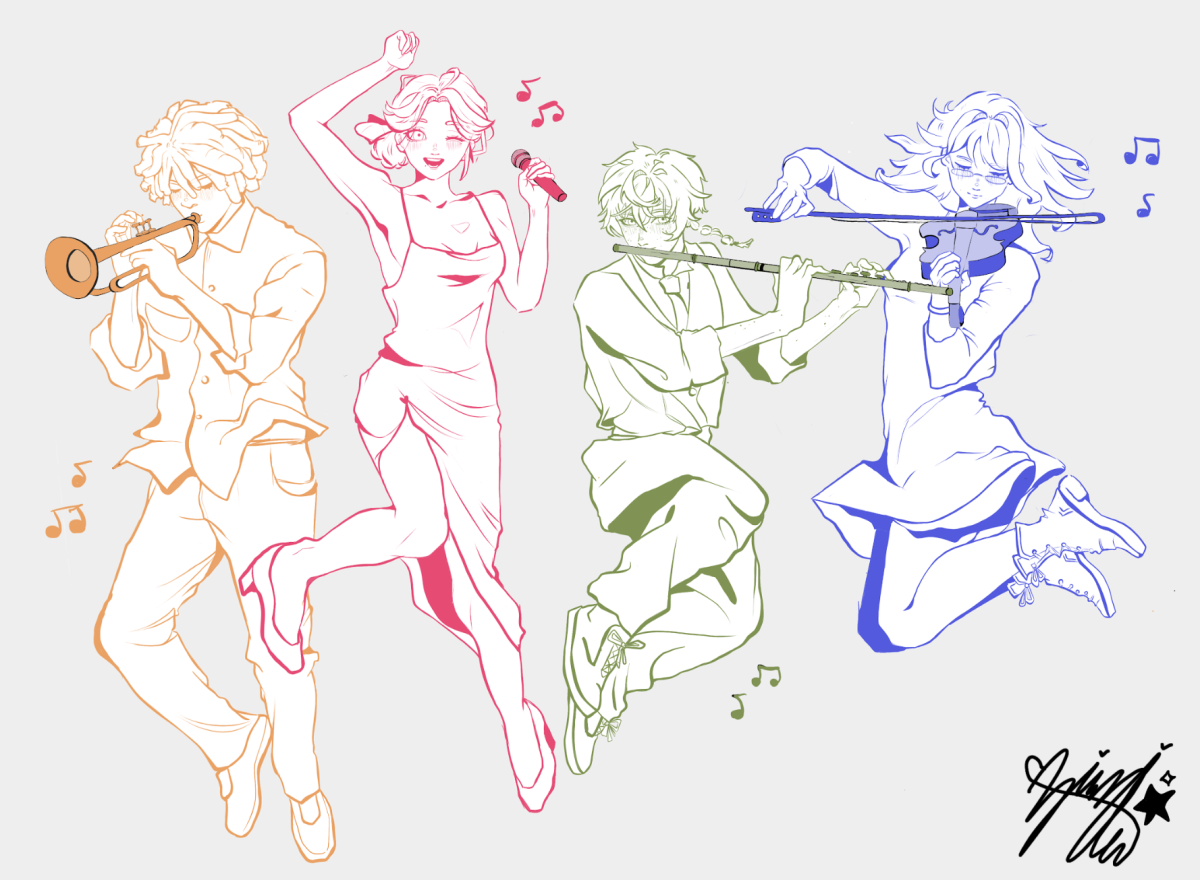
Walking past the Hubbard Music Center, it is hard to miss the diverse sounds of music overlapping each other: from the beautiful voices, to the grandness of the cello, to the bright and pure whistling of the flutes, all the way to the vibrations and thunking of the percussion. All these melodious sounds are performed after hours of practice and commitment from the fervent Loomis musicians. This year, 29 of these top musicians from Loomis participated in the CMEA Northern Region Music Festival.
Ms. Susan Chrzanowski, Department Head of Performing Arts, shared some of the insight about the CMEA regarding what it is like and how students are able to get in.
“[There are students] ranging from public schools and private schools, and they are the ones who scored high enough at their auditions to participate in the Northern Region,” she said.
During the festival, students are engaged in a wide range of fields in music from band, jazz band, orchestra and two choruses. “The festival itself is the kind of reward weekend or the exciting weekend for all the students who auditioned in November,” Ms. Chrzanowski said.
Being able to perform and relish the festival is certainly fulfilling after several months of persistent efforts to prepare for the audition. However, the behind the scenes of the audition process is not a straightforward task.
Alice Yu ’28, who played the flute in the regional band, shared information about her audition process. “For flutes, we got two pieces from the etude book, as well as sight reading and scales. I started practicing the two pieces during summer, and after I got back to school, I worked with my music teacher on the details like adjusting the dynamics and perfecting them,” Yu ’28 said.
Just practicing their solos is not enough, however. Ms. Chrzanowski mentioned that the audition depends on the time students have been studying their instrument and their musicality.
“Usually it is quite challenging, especially with the advanced etudes [and] concerto excerpts,” she explained. Thinking carefully about their breath support, intonation, dynamics and tempo plays a significant role in their scores.
Despite the demanding audition practices, the experience students get once they play in the music festival seems to be truly special, and distinguishes them from performing in a school music group.
“The biggest difference [between playing in a school band versus playing in this festival] was how fast paced it is. Normally, in a school band, we have a longer time frame, but for regionals we only have two days to rehearse and perform,” Yu ’28 said.
“Everybody is at the top of their game in these festivals. These are all devoted musicians,” commented Ms. Chrzanowski. “In a typical Loomis ensemble, [there is a] nice big combination of people with lots of experience, people with little experience, people with very strong interest to people who are just beginning to have interest, whereas when you go to a regional festival, everybody’s there because they have been practicing for a long time and prepared for a long time.”
Klara Oppenheimer ’28, who performed in the treble choir, spoke about the top-notch experience that was different from how she felt in choirs at Loomis Chaffee.
“In the treble choir, there were numerous singers who had a strong music background. [From those advanced singers], I was able to learn from them in terms of being in the right rhythm and how to approach a song as well as from the conductors,” she said.
Similarly, Matthew Li ’26, who played the french horn in the orchestra, commented, “I liked how I got the chance to play with the strings and pay attention to the tone and overall warmness of playing with different musicians instead of individually playing.” Participating in the music festival is not just about playing the music, but truly cherishing the interaction with the guest conductors and new peers. This sentiment was echoed by Yu ’28 as she provided insight into the built in Q&A session in between the breaks, specifically the conducting workshops.
“The conducting exercises helped me realize how the different gestures evoke different reactions and responses when I play the instrument,” she commented. She also noted the valuable tips offered from the guest conductors such as the process of going into music majors or minors.
Clearly, participating in the CMEA created gratifying and unforgettable memories to all the student musicians and provided much room to grow. Ms. Chrzanowski hopes to add a positive note to those who might be hesitant to try out. “I would say go for it! We’re very happy to help,” she said. “Having the experience of working intently on a challenging piece of music and watching yourself grow over a period of two or three months is immensely rewarding.”