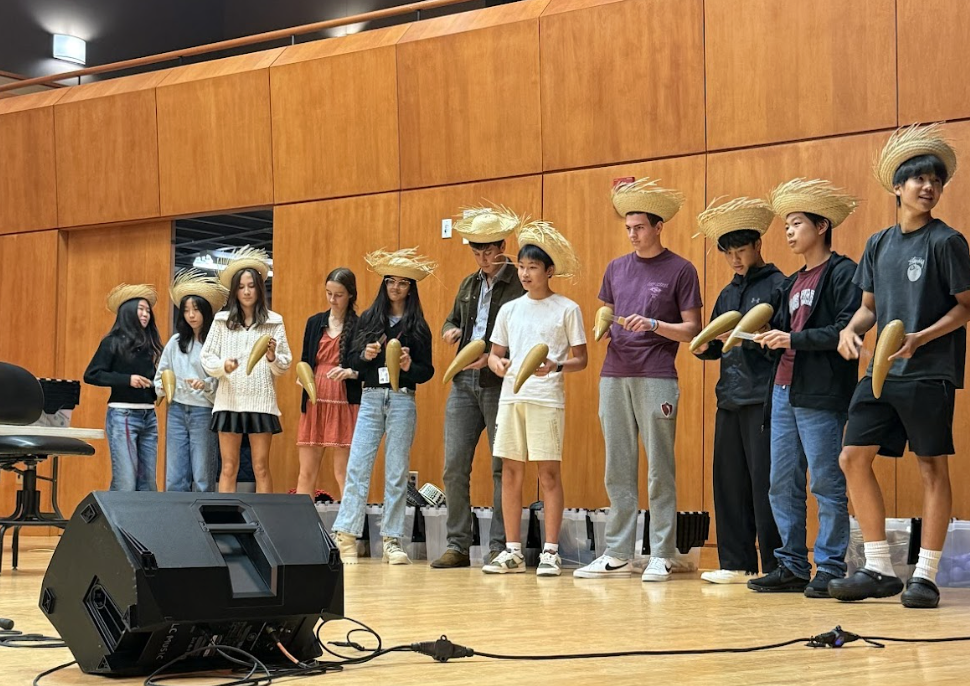
On Monday, October 20th, our very own Hubbard Performance Hall, with its walls illuminated with vibrant maps of South America and Africa, was transformed into a celebration of global culture. The stage, instead of its usual wooden backdrop, was lined with an assortment of unique, traditional instruments that set the tone for an afternoon of lively performances and engaging workshops from guest musicians Lorena Garay and her award-winning performance group Surcari.
Surcari – a name that combines two Spanish words meaning “South America” and “Caribbean” – is a versatile band that performs with a wide range of traditional instruments. Through their music, they share a deep passion for their cultural heritage, intertwining the vivid rhythms of South America and the Caribbean. The group has performed for audiences of all ages across the United States, South America, and Europe, hoping to share the flair and distinctiveness of their cultural sounds.
“The stage was scattered with instruments that looked to be very similar from my seat in the back row,” Freshman Surene Cho ‘29, an enthusiastic member of the Chamber Choir, remarked. “But when Lorena Garay began to play them, they all produced unexpectedly unique sounds, giving each instrument its individuality.”
Lorena Garay, a proud Puerto Rican and the leader of the trio, is a multi–award-winning guitarist who performs a wide range of styles, from classical to Spanish and Latin jazz.
“It took me aback that even though she was from one place, she took the time to take us through so many countries’ unique backgrounds.” Tayla Hadari ’28, a sophomore Music Leader and a cellist of the Chamber Orchestra, said. “It really showed that though places can be different, music can bring them together in a way words can’t.”
All three members of Surcari come from very different backgrounds. Eugenio Huanco, a native of Chile and master of the panpipe, has performed at some of the world’s most prestigious venues, including Carnegie Hall and Lincoln Center, and even crafts his own instruments. Completing the trio is violinist, bassist, composer, and music teacher Edilio Bermudez. He is a Berklee College of Music alum who pursued an art diploma in Jazz performance and has shared a stage with multiple world-renowned musicians.
When asked about her most memorable moment of the workshop, Performing Arts Department Head Ms. Sue Chrzanowski said: “In general, I just loved how our students would go up and try.” She also remarked that she was pleasantly surprised by the students’ willingness to put on the Mexican hats for the experience. “How symbolic, right? To try on the hat is kind of like ‘let me on this way of playing the maracas, or this way of playing the claves, this way of playing the drums. It might not be from what I know, but I could try it on, see how it works and be a part of it.”
Indeed, the workshop was a great success at Loomis, and drew enthusiastic participation from our performing arts students. “I remember Garay offering traditional clothing or accessories to each volunteer that came up onstage to play.” Surene ’29 remarks. “The garments were unique to each culture, and helped to foster a richer, more cultural environment accompanied by the music.”
Reflecting on the event, Ms. Chrzanowski shared one of her hopes for what students would take away from the performance: “Just to enjoy. To relax and really immerse yourself in it and just be part of it. To gain an understanding of cultures or music or art forms that we might not have experienced before.”
Ultimately, the Surcari workshop did just that – bringing new music heritage into an ordinary afternoon and transforming it into a wonderful learning and celebration of South American and African culture.